Stonework in Edinburgh: harling, repointing & masonry
Stonework is the repair and protection of a building's masonry — repointing failed mortar joints, harling (roughcasting) walls, and rebuilding chimneys and parapets — keeping traditional stone weathertight and sound, which much of Edinburgh's listed and conservation-area stock needs.
Reviewed by Ronald Graham, Fellow of the Institute of Roofing (FIoR) · Last updated July 2026
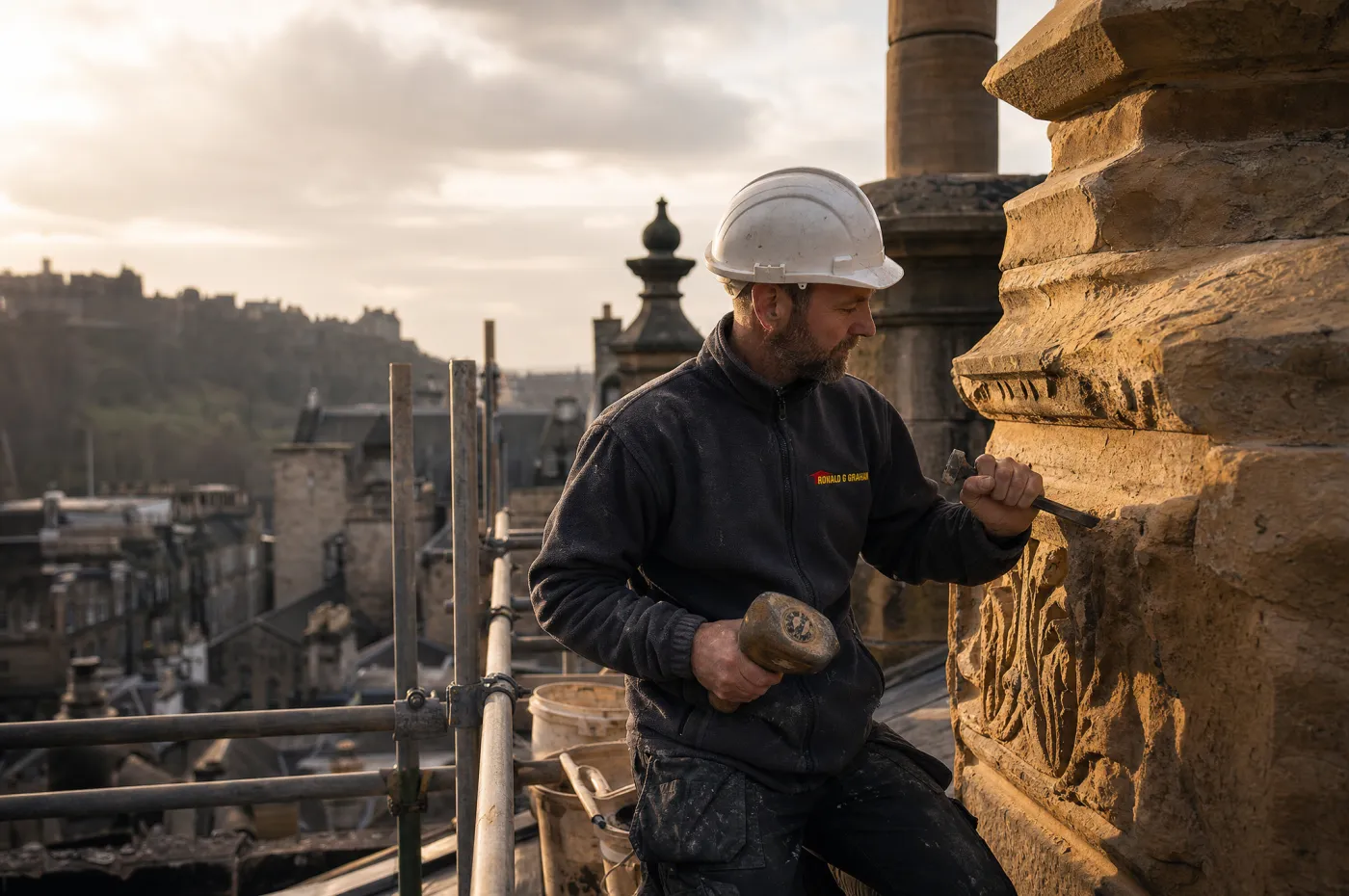
Where the roof meets the masonry
Roofing and stonework are inseparable on a traditional Scottish building. The points that fail most — chimneys, parapets, skews, gable abutments — are where slate, lead and stone all meet, and a leak that looks like a roof problem often turns out to be cracked masonry or eroded mortar above it. Because we work in both trades, we can trace the real cause and put the whole junction right, rather than renewing flashings against stonework that's still letting water in.
Edinburgh is overwhelmingly a stone-built city, and much of it sits within a conservation area or involves listed buildings. That raises the bar on materials and method: external masonry, harling and repointing are expected to match the original, and often need listed building consent or planning permission. We work to those standards as standard, and can advise on or liaise about consents before a job begins.
Harling, repointing and rebuilds
The three jobs that keep stone walls and stacks sound are harling, repointing and chimney work — and each rewards doing properly with the right materials.
- Harling (roughcast) — hand-cast lime or cement render that coats and protects the wall from driving rain, patched or renewed to match the existing texture
- Repointing — raking out failed mortar and renewing it, using breathable lime mortar on traditional stone rather than hard cement that traps moisture
- Chimney repairs and rebuilds — from re-flaunching and re-pointing a sound stack to a full rebuild in matching material with new lead, pots and flaunching
- Parapet, skew and coping repairs — the exposed copings and parapets that take the worst weather and shed water onto everything below
- Stone replacement and indenting — cutting out spalled or eroded stone and matching it in
What's included
- Survey and diagnosis of failed mortar, spalled stone and leaning stacks
- Lime and cement repointing matched to the building's age
- Harling and roughcast — patch repairs and full renewal
- Chimney rebuilds with new lead, flaunching and pots
- Parapet, coping and skew repairs
- Integrated leadwork at every masonry-to-roof junction
- Photo work report on completion
Done to last on period buildings
The single biggest mistake on old Scottish stone is hard cement mortar. Traditional walls were built with lime, which is soft and breathable; cap them in cement and moisture gets trapped against the stone, which then takes the wear and erodes faster. Like-for-like lime repointing protects the masonry instead of quietly damaging it — the kind of detail that separates a repair that lasts from one that looks fine and causes harm. Every chimney we rebuild ties straight into new leadwork, and where a stack needs a fresh covering above, our copper and zinc work finishes it.
For the bigger picture on period roofs and masonry, read our guide to heritage roofing in Edinburgh, or compare roof coverings in slate vs tile. To get a stack, wall or parapet looked at, book a free survey and we'll give you a straight diagnosis and a fixed written quote.
From the survey to the finished roof, everything was on time, tidy and exactly what we were quoted. You can tell it's a proper family firm that cares about the work.
Get a free survey for your roof
No obligation, no pushy sales — just an honest look and a clear written quote.
Book a free survey 0800 234 3243Common questions
What is harling?
Harling — also called roughcast or wet dash — is a traditional Scottish render where a wet lime or cement mix, mixed with fine aggregate, is thrown (cast) onto a wall by hand. It coats and protects the masonry from Scotland's driving rain while letting older walls breathe. It's the textured finish you see across countless Edinburgh and Lothians buildings, and it needs the right mix and the right hand to do well.
What's the difference between repointing and pointing?
Pointing is the mortar finish in the joints between stones or bricks. Repointing is renewing it — raking out the old, failed mortar and replacing it. On older Edinburgh stone, repointing should usually use a lime mortar rather than hard modern cement, because lime flexes and lets the wall breathe; cement traps moisture and can accelerate decay of the surrounding stone.
Why does my chimney need rebuilding?
Chimneys take more weather than any other part of a building — exposed on all sides, above the roofline. Over decades the mortar erodes, the stone or brick spalls and cracks, the flaunching round the pots breaks up, and the whole stack can lean or become unsafe. A rebuild takes it down to a sound course and rebuilds in matching material with new lead, flaunching and pots, rather than patching a structure that's past it.
Do I need consent for stonework on a listed building?
Often, yes. Much of Edinburgh is within a conservation area or involves listed buildings, where external masonry, harling and repointing can require listed building consent or planning permission, and the materials and methods are expected to match the original. We work to those standards as a matter of course and can advise on or liaise about the consents a job needs before it starts.
Why use lime mortar instead of cement?
Traditional Scottish stone was built with lime mortar, which is softer and breathable. It lets moisture move out of the wall and flexes slightly with movement and temperature. Hard cement mortar does the opposite — it traps water against the stone and is harder than the masonry around it, so the stone takes the wear and erodes faster. On period buildings, like-for-like lime repointing protects the stone; cement can quietly damage it.
Do you do stonework as part of roof repairs?
Yes — masonry and roofing meet constantly at chimneys, parapets, skews and gable walls, and we handle both. When a leak traces back to cracked chimney stonework or failed parapet pointing rather than the slates, we put the masonry and the leadwork right together in one visit rather than sending you to a separate trade.
Explore further.
Leadwork & lead flashings
Hand-formed lead that pairs with every chimney rebuild and parapet repair.
Read moreCopper & zinc roofing
Long-life metal roofing for dormers, bays and complex period roofs.
Read moreHeritage roofing in Edinburgh
How listed and conservation-area buildings are repaired sympathetically.
Read moreNeed this done properly?
A free, no-obligation survey and a fixed written quote from Edinburgh's award-winning family roofers.