Leadwork & lead flashings in Edinburgh
Leadwork is the craft of forming sheet lead into valleys, flashings and soakers that waterproof the joints where a roof meets a wall, chimney or another slope — the details that keep more water out than the slates ever do.
Reviewed by Ronald Graham, Fellow of the Institute of Roofing (FIoR) · Last updated July 2026
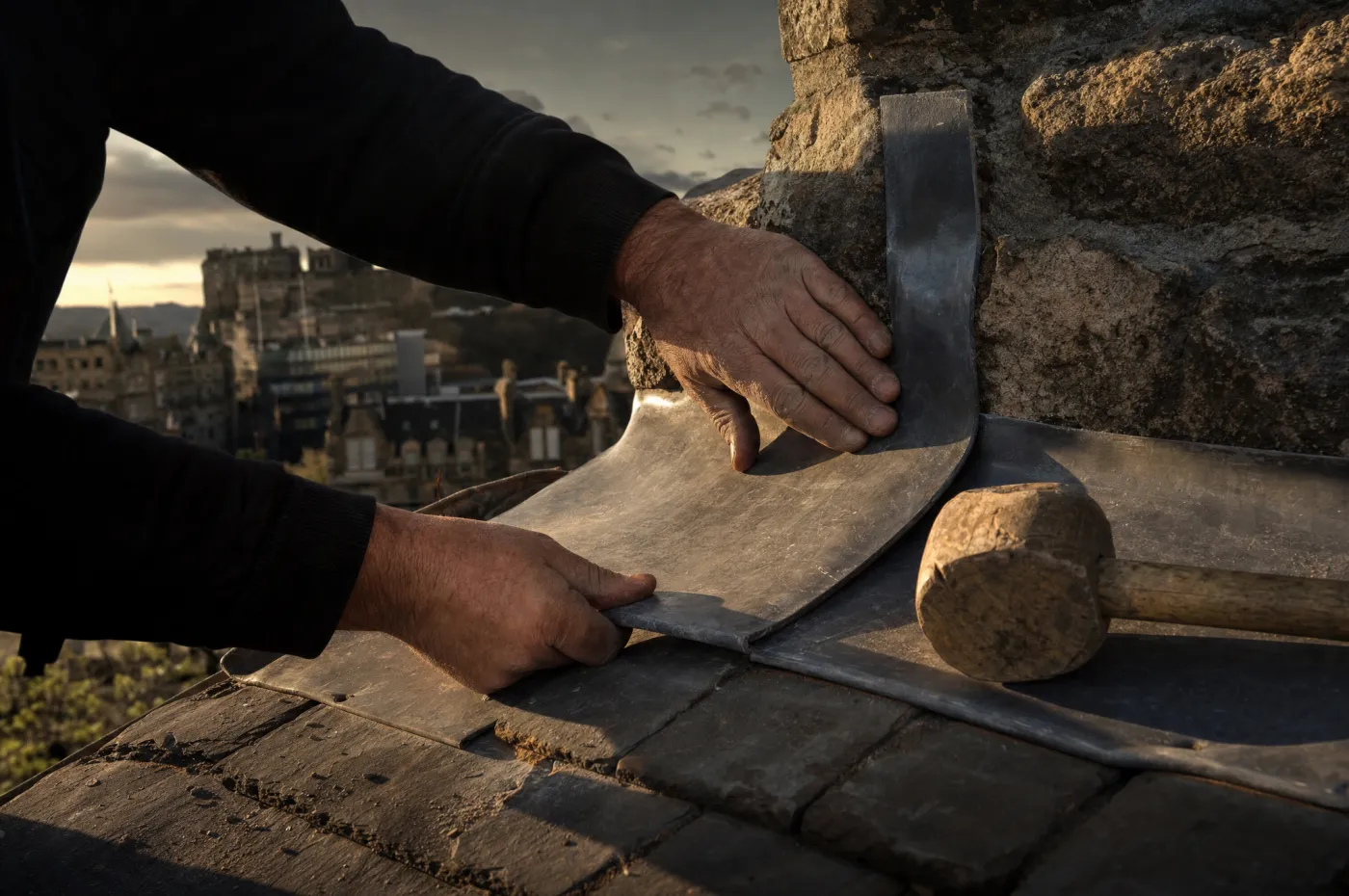
The detail that keeps a roof dry
A pitched roof sheds rain off its open slopes easily. The hard part is everywhere it doesn't — the valley where two roof planes drain into each other, the line where the roof runs into a gable wall, the four faces of a chimney, the apron under a dormer window. These junctions are where leaks start, and where hand-formed lead earns its keep. Properly dressed sheet lead is malleable enough to mould around any awkward shape, then holds that shape for decades.
We form lead on site to Lead Sheet Association detail — the recognised standard for how lead should be sized, laid, lapped and fixed. That means correctly graded sheet, bays kept to the right length so the metal can move with temperature without splitting, and proper clips, welts and lead wedges rather than relying on mortar alone. The difference between leadwork that lasts six decades and lead that fails in six years is almost entirely in that detailing.
Where we use lead
Lead does jobs no other material does as well on a traditional Scottish roof. We renew and repair it across both heritage stock and modern builds, sizing the code to each location — Code 4 for soakers and smaller flashings, Code 5 for valleys, chimneys and exposed work.
- Valleys — the lead-lined channels where two roof slopes meet and drain together
- Chimney leadwork — front aprons, stepped side soakers, back gutters and cover flashings, wedged and pointed in
- Abutment flashings — where a roof runs into a wall, gable or neighbouring property
- Soakers — the hidden lead pieces interleaved with slates at wall junctions
- Dormer and bay leadwork — aprons, cheeks and tops on dormer windows and projecting bays
- Ridge saddles, hips and parapet gutters on the more complex roofs
What's included
- Survey and diagnosis of where water is actually getting in
- Hand-formed Code 4 and Code 5 lead to Lead Sheet Association detail
- Full chimney lead sets, not single-face patches
- Raking out, re-wedging and repointing of all lead chases
- Matched detailing on listed and conservation-area roofs
- Patination oil finishing to prevent staining and white run-off
- Photo work report on completion
Heritage leadwork in Edinburgh
Edinburgh's tenements, terraces and villas were built to be lead-detailed, and much of the city falls within a conservation area or involves listed buildings. Sympathetic leadwork is one of our specialisms: we match the look and method of the original work so a repair disappears into the roof rather than standing out as a patch. Where new lead sits beside stonework that's also failing — a cracked chimney head, eroded pointing — we handle the stonework and repointing as part of the same visit, so the whole junction is made good together.
For a wider view of how period roofs are repaired properly, see our guide to heritage roofing in Edinburgh, or compare coverings in slate vs tile. When you're ready, book a free survey and we'll tell you honestly whether your lead needs renewing or just re-dressing.
From the survey to the finished roof, everything was on time, tidy and exactly what we were quoted. You can tell it's a proper family firm that cares about the work.
Get a free survey for your roof
No obligation, no pushy sales — just an honest look and a clear written quote.
Book a free survey 0800 234 3243Common questions
What is lead used for on a roof?
Lead waterproofs the joints a roof covering can't seal on its own. It forms valleys where two slopes meet, flashings and soakers where the roof abuts a wall or chimney, aprons at dormer fronts, saddles over ridges, and cover and cap flashings at upstands. Anywhere water has to turn a corner or run against masonry, hand-formed lead is the traditional and longest-lasting answer.
What is Code 4 and Code 5 lead?
Lead sheet is graded by thickness, each code colour-coded to BS EN 12588. Code 4 (1.80mm, blue) is the workhorse for soakers, smaller flashings and dormer cheeks. Code 5 (2.24mm, red) is used for valleys, larger flashings, chimney work and exposed areas that take more weather and wear. We specify the code to the Lead Sheet Association detail for each location rather than using one weight throughout.
Why does lead flashing fail?
Most lead failures aren't the lead itself — properly fixed Code 4 or 5 lasts 60 years or more. They come from oversized pieces fitted in single lengths, which expand and contract until they split, or from mortar pointing that's cracked and let the flashing pull out of the chimney. We renew lead in correctly sized bays with proper laps, clips and lead wedges so it can move without fatiguing.
Can you repair lead on a listed building or in a conservation area?
Yes. Much of Edinburgh sits within a conservation area or involves listed buildings, and hand-formed leadwork to Lead Sheet Association detail is exactly what those properties need. We match the look and the method of the original work so the repair reads as part of the roof, and can advise on or liaise about any consents needed before work starts.
Do you replace lead flashing around chimneys?
Yes — chimney leadwork is one of the most common leak sources we put right. A chimney needs a front apron, side soakers stepped into the brickwork, cover flashings and a back gutter, all dressed and wedged into raked-out joints and re-pointed. We renew the full set rather than patching one face, because a chimney is only as watertight as its weakest flashing.
How long does lead flashing last?
Correctly sized and fixed Code 4 or Code 5 lead routinely lasts 60 years or more, often outliving the roof covering around it. That longevity is the whole case for lead over cheaper substitutes: it's a one-off cost that doesn't come back round in a decade.
Explore further.
Copper & zinc roofing
Traditional and standing-seam metal roofing where lead won't do the whole job.
Read moreStonework, harling & pointing
Chimney rebuilds and repointing that go hand in hand with new leadwork.
Read moreHeritage roofing in Edinburgh
How listed and conservation-area roofs are repaired the right way.
Read moreNeed this done properly?
A free, no-obligation survey and a fixed written quote from Edinburgh's award-winning family roofers.