Zinc & copper roofing in Edinburgh
Copper and zinc roofing covers a roof in long sheets of folded metal, joined by raised standing seams, to make a continuous covering that weathers to a natural patina and lasts well beyond a human lifetime — copper over 100 years, zinc 80 to 100.
Reviewed by Ronald Graham, Fellow of the Institute of Roofing (FIoR) · Last updated July 2026
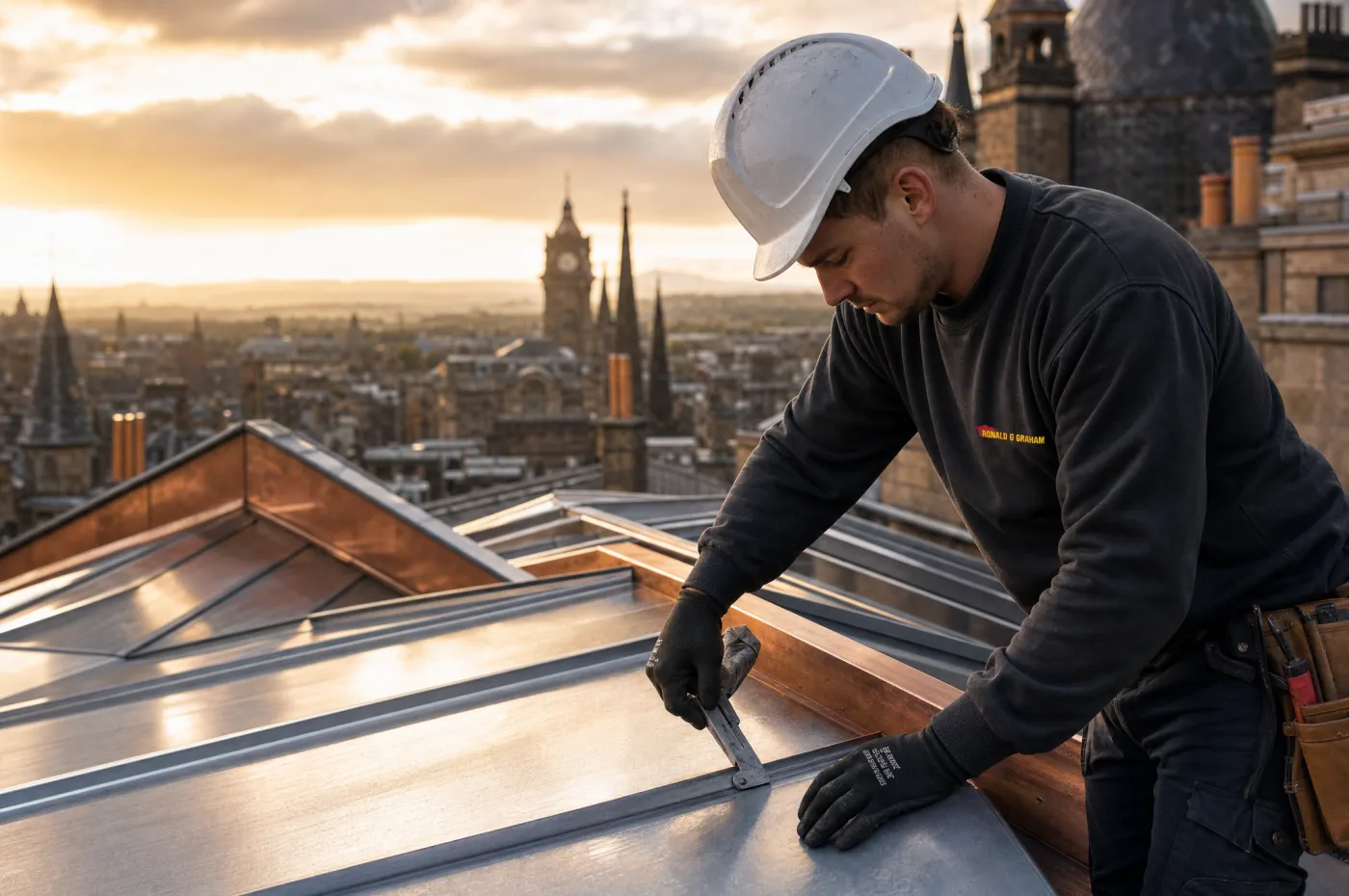
Metal that outlasts the building round it
Copper and zinc are the long-game roofing metals. Instead of overlapping slates or a membrane that ages and is replaced, they go down as continuous folded sheets and then weather rather than fail. Copper shifts from bright orange-brown to its familiar verdigris green; zinc settles quickly into a matt blue-grey. That colour change is a patina — a protective skin the metal grows itself — and it's exactly why these roofs survive a century or more with almost no maintenance.
The usual system is standing seam: panels run unbroken from ridge to eaves, joined by raised, folded seams that hold the joints up out of the running water. The panels are clipped, not pierced, so the metal can expand and contract with the weather without splitting or pulling its fixings. The result is a crisp, seamless roof that looks as right on a contemporary extension as it does on a period turret.
Heritage and contemporary, both
Metal roofing isn't one or the other. On Edinburgh's older stock — bays, dormers, porches, turrets and curved roofs where slate simply won't lie — copper and zinc have a long traditional precedent and are routinely specified on listed and conservation-area work. On modern homes and commercial buildings, architects reach for standing-seam zinc for the clean, continuous lines that tiles and membranes can't deliver. We work across both: sympathetic repairs that match what's there, and new metal roofs on contemporary builds.
Where a metal roof meets stonework, parapets or chimneys, the detailing is everything. We tie metal roofing in with our leadwork at abutments and flashings, and handle any stonework, parapet and chimney repairs at the same time, so the whole assembly is made watertight as one job rather than left as separate trades.
What's included
- Survey and advice on copper vs zinc for your building and budget
- Standing-seam copper and zinc roofs, new and replacement
- Dormers, bays, turrets, porches and curved or complex roofs
- Decking, breather membrane and ventilation set up correctly beneath
- Integrated lead flashings and abutment detailing
- Sympathetic metalwork on listed and conservation-area roofs
- Photo work report on completion
The case for metal in Edinburgh
The cost of a copper or zinc roof is front-loaded — it's more than felt or single-ply up front, and then it largely stops costing you. A copper roof comfortably outlasts the people who commission it; zinc gives 80 to 100 years for less outlay. Against a flat roof that needs redoing every 20 to 30 years, the metal often wins over the life of the building. It's also a genuinely beautiful covering on the right roof, which is why so much of it ends up on the features people most want to look good.
For the wider context on period roofs, read our guide to heritage roofing in Edinburgh, or weigh up coverings in slate vs tile. To talk through copper or zinc for a specific roof, book a free survey and we'll give you an honest steer and a fixed written quote.
From the survey to the finished roof, everything was on time, tidy and exactly what we were quoted. You can tell it's a proper family firm that cares about the work.
Get a free survey for your roof
No obligation, no pushy sales — just an honest look and a clear written quote.
Book a free survey 0800 234 3243Common questions
What is standing-seam roofing?
Standing seam is a metal roofing system where long sheets of copper or zinc run from ridge to eaves, joined by raised, folded seams that stand proud of the surface. Those upstand seams keep the joints clear of running water, and the panels are clipped to the deck so the metal can expand and contract freely. It gives a clean, continuous, low-maintenance roof that suits both contemporary buildings and sympathetic heritage work.
How long does a copper or zinc roof last?
A properly installed copper roof can last well over 100 years, and zinc commonly lasts 80 to 100. Both far outlast typical felt or single-ply flat roofs and rival natural slate. The metal weathers rather than degrades, which is why so much of it survives on historic European buildings — the cost is front-loaded into one long-life roof rather than repeated replacements.
Why does copper turn green and zinc turn grey?
Both metals form a protective surface layer — a patina — as they react with the air. Copper moves from bright orange-brown through brown to the familiar verdigris green over years or decades. Zinc develops a matt blue-grey patina far quicker. That patina isn't corrosion; it's a self-sealing skin that protects the metal beneath and is the main reason these roofs last so long with almost no maintenance.
Can metal roofing be used on a listed building?
Yes, and it often is — lead, copper and zinc are traditional roofing metals with long heritage precedent in Scotland. On listed and conservation-area properties the system and finish are chosen to suit the building, and we can advise on or liaise about consents. Metal is frequently specified for dormers, bays, turrets, porches and curved or complex roofs where slate won't sit.
Is copper or zinc better for my roof?
It depends on look, longevity and budget. Copper is the premium choice — the longest lifespan and the warm-to-green weathering many people want on a feature roof. Zinc costs less, weathers to a contemporary blue-grey, and is very workable for complex shapes, which makes it popular on modern extensions and dormers. We'll talk through both against your building and budget at the survey.
Do you do metal roofing on modern extensions, not just heritage?
Yes. Standing-seam zinc and copper are popular on contemporary extensions, dormers and architect-designed builds precisely because they give a crisp, seamless finish that membranes and tiles can't. We work across both ends — sympathetic repairs on period roofs and new metal roofs on modern homes and commercial projects.
Explore further.
Leadwork & lead flashings
Hand-formed lead valleys, flashings and chimney work to Lead Sheet Association detail.
Read moreStonework, harling & pointing
Masonry, parapet and chimney repairs that often accompany a metal re-roof.
Read moreHeritage roofing in Edinburgh
Traditional materials and detailing for listed and conservation-area roofs.
Read moreNeed this done properly?
A free, no-obligation survey and a fixed written quote from Edinburgh's award-winning family roofers.