Pitched roofs explained — types, materials and trade-offs
A plain-English guide to pitched roofs, the common designs (including gable), where each one works, and the slates and tiles most often used to cover them.
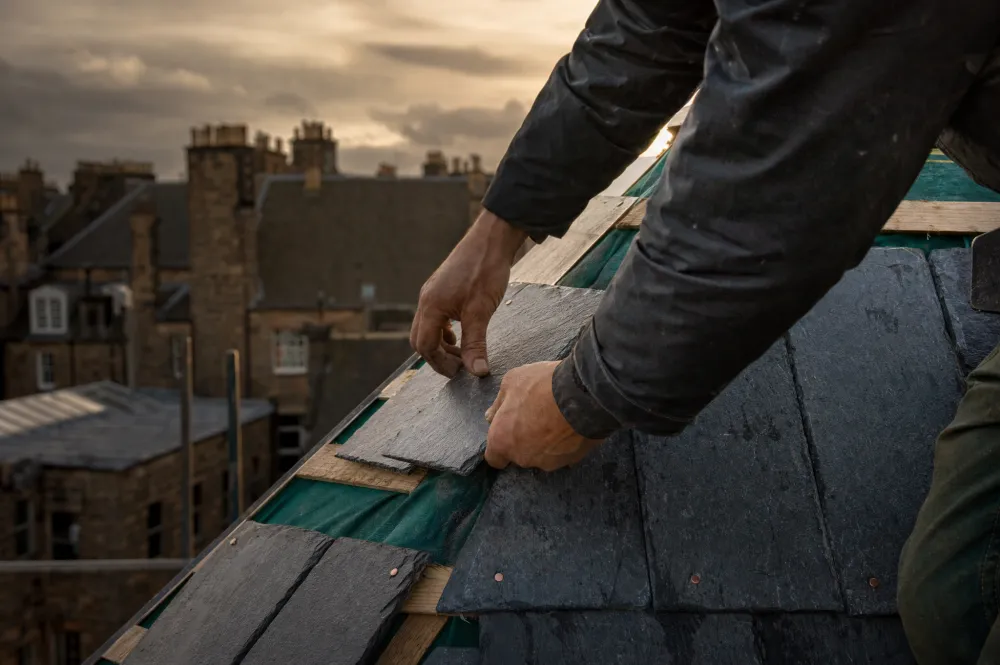
A pitched roof is one with sloping sides that rise to meet at a ridge, typically angled between roughly 12.5 and 85 degrees, shaped like an inverted V. It is the most common roof type in the UK because it sheds rain and snow efficiently, copes with wind, and gives you usable loft space. The main designs are gable, mono-pitch, couple and collar roofs, finished with slate or tile.
The right design depends on the size and layout of your property, and the covering you choose changes how it looks, what it costs and how long it lasts. This guide walks through the main types, the materials that go on them, and the trade-offs to weigh up.
What counts as a pitched roof
A pitched roof slopes downwards at an angle, usually somewhere between roughly 12.5 and 85 degrees. Anything shallower than about 12.5 degrees is generally treated as a flat roof, which is a different job with different materials. If you are weighing a pitched re-roof against a flat alternative on an extension, our guide to the benefits of a flat roof covers the other side.
Once the structure is built, the slopes are covered with tiles or slates clipped or fixed to the battens — strips of timber fixed across the rafters at regular spacing. The other component that does a lot of quiet work is the lead flashing. You’ll find it wherever water could find a way in: around the chimney stack, at abutments, and where the roof meets a wall. Get the flashings wrong and even a perfect set of slates will leak.
Larger houses often carry several pitches to make the most of the upper floors, along with features like gable ends, eaves and dormers.
Common pitched-roof designs
Double-pitched (gable)
The most common design. Two slopes rise to meet at a central ridge. It can be symmetrical, where both slopes form a clean triangle, or asymmetrical, where the ridge sits off-centre and the two faces aren’t equal. The triangular wall at each end is the gable — which is where the gable roof gets its name.
Mono-pitch
A single slope, lower than the main ceiling line. It’s often used as a secondary roof over an extension or lean-to rather than as the main roof of a house.
Couple roof
The most basic form, where opposing rafters slope up to meet at a central ridge. It’s rarely used now: without lateral support it’s prone to spreading and to damage in severe weather.
Collar roof
A variation that adds a horizontal tie (a collar) to brace the rafters. It avoids some of the weaknesses of the couple roof, but spans are limited — around 4.5 metres at most — so it’s a niche choice rather than a common one.
Gable roofs in more detail
The standard gable roof is the workhorse of UK housing: two slopes, a ridge, and a triangular gable wall at each end. It’s popular in cooler, wetter climates like ours because it sheds water and snow well, it’s relatively cheap, and it’s straightforward to build — only two roof planes to cover, with no wasted material over the gables.
There are a few variations worth knowing:
- Box gable — close to the standard design but with a boxed triangular overhang at each end, emphasising the shape. It uses a little more material than a plain gable.
- Front gable — the gable faces the front of the house, often over the entrance, and frequently forms a porch where the roof projects beyond the wall.
- Dutch gable (gablet) — a gable section sitting on top of a hipped roof, combining features of both. In the UK this is usually called a gablet rather than a Dutch gable. It looks distinctive but tends to give you less attic space.
The main weakness of a gable roof is wind. Because the pitch is steeper and the gable wall is large, a poorly built or poorly maintained gable is more exposed in storms. Sound construction and the right fixings make a big difference to how it holds up.
Coverings: tiles and slates
The covering is where looks, cost and longevity come together. These are the options you’ll see most often on pitched roofs.
Interlocking tiles
Tiles designed to lock together at the edges — the family that includes pantiles and double Romans. They’re larger than plain tiles, so they go on faster and work out cost-efficient on straightforward roofs, which makes them popular with developers. On more complex roofs, though, their size means more cutting, which eats into that time saving.
Plain tiles
A more traditional look, with a varied, textured finish that’s quite different from interlocking tiles or slate. Machine-made plain tiles cover the budget end; hand-made plain tiles sit at the top end and are exceptional quality.
Slate
Natural slate has been used on UK roofs since the early 18th century, drawing on good-quality stone from the Lake District, Wales and Cornwall — with the railways later making it practical to transport long distances. It’s durable, handsome and very much at home on Scottish properties. If you’re weighing slate against tile, our guide to slate roof lifespan in Scotland goes into the detail.
Weighing it up
Pitched roofs are the default for UK homes because they handle our weather, add loft space and look right on traditional properties. The trade-offs are real, though: a quality pitched roof costs more to build than a simple flat roof, and a steep, exposed design needs regular maintenance — more so in spots that take a battering from wind and rain. Knowing the early signs your roof needs attention helps you act before a slipped slate becomes a leak.
Get advice on your roof
If you’re planning a re-roof, an extension, or just want a straight opinion on what suits your property, book a free no-obligation survey and we’ll talk you through the options. You can also see the full range on our services page.

Frequently asked questions
What is the minimum pitch for a pitched roof?
In the UK a roof is generally considered pitched once it slopes at around 12.5 degrees or more. Below that it is treated as a flat roof and needs a different waterproofing approach, such as felt or a single-ply membrane.
What is the most common type of pitched roof?
The double-pitched gable roof is by far the most common in UK housing: two slopes rising to a central ridge with a triangular gable wall at each end. It sheds water and snow well, is relatively cheap and is straightforward to build.
Should I choose slate or tile for a pitched roof?
It depends on the property and budget. Natural slate is durable, handsome and well suited to Edinburgh and wider Scottish properties; tiles, especially interlocking ones, are quicker and more economical to lay. Our guide to slate roof lifespan in Scotland goes into the detail.
What is the weakest point of a gable roof?
Wind. Because the pitch is steeper and the gable wall is large, a poorly built or poorly maintained gable is more exposed in storms. Sound construction, good fixings and well-formed flashings make a big difference to how it holds up.